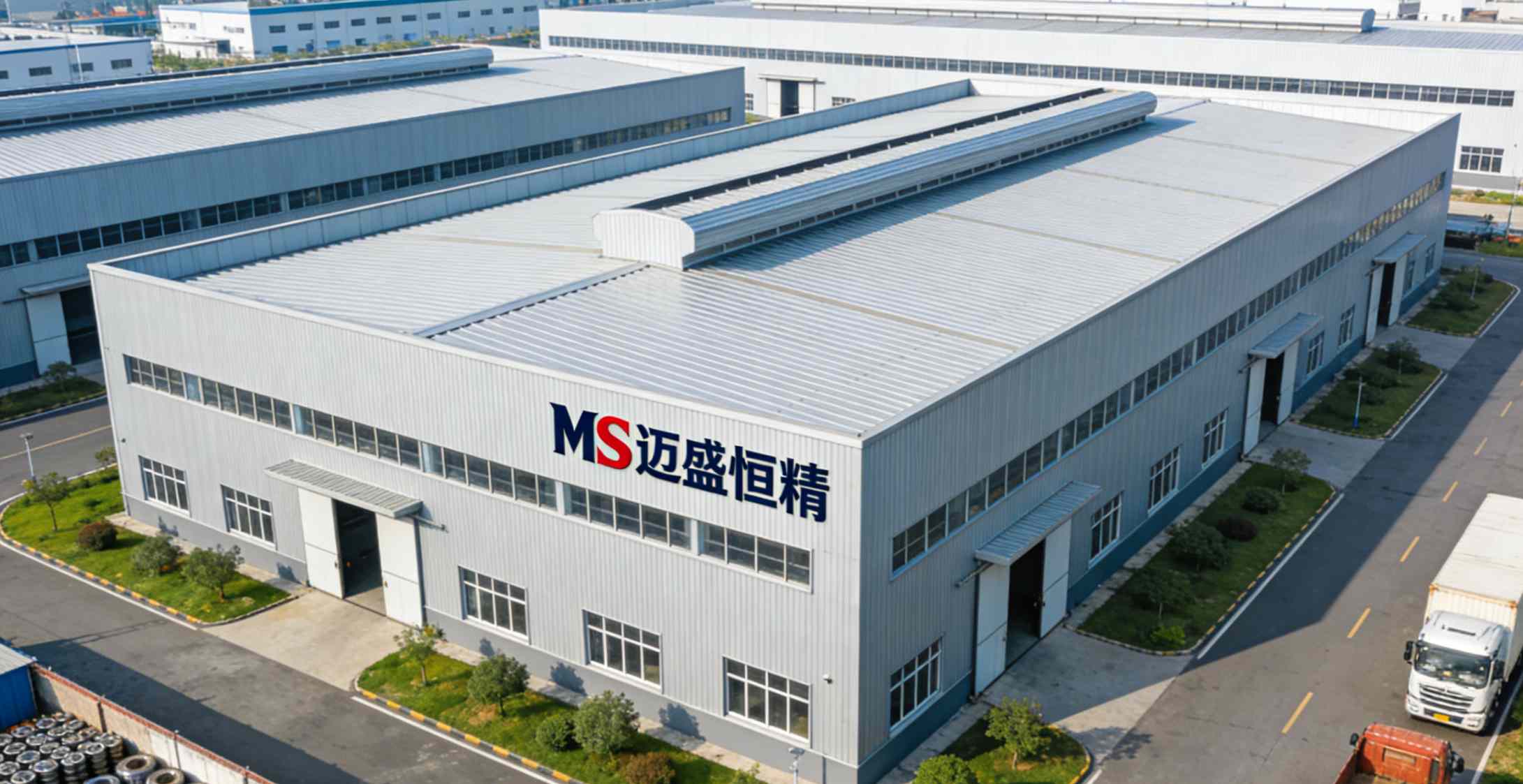

A China ball bearing factory is a vertically integrated manufacturing plant that presses, machines, heat-treats, and assembles bearings under one roof, with ISO 9001:2015 quality controls and factory-direct export channels. MS Bearings in Kunshan, Jiangsu (founded 2019) runs 28 production lines across 10 product families and ships to more than 30 countries. An OEM buying from a China ball bearing factory can replace SKF, FAG, or NSK equivalents with validated dimensional tolerances, defined lead times, and full traceability from raw steel to finished unit.
Why import from a China ball bearing factory? The direct cost gap comes from eliminating distributor margins, minimum-order packaging, and multi-node logistics, while ISO 9001:2015 inspection routines and retained samples make quality auditable before shipment. According to MS Bearings factory data 2024, tolerance compliance is verified on every batch and test reports ship with each order, per ISO 15:2011 metric tolerances and customer drawing calls.
Where is the real production base? Most ball bearing capacity sits in the Yangtze River Delta, especially Kunshan and neighboring cities in Jiangsu, where bearing steel, forgings, and cages are localized. MS Bearings’ factory uses automated machining cells, controlled atmosphere heat treatment, and end-of-line noise testing so lot consistency is managed in-process, not only at final inspection.
What a China Ball Bearing Factory Actually Produces
A China ball bearing factory should be evaluated on process capability, not on marketing claims.
- Ten product families: deep groove ball, self-aligning ball, cylindrical roller, tapered roller, spherical roller, needle roller, angular contact, thrust bearings, mounted bearings, and non-standard custom bearings
- Core processes: ring forging/blanking, turning, grinding, super-finishing, heat treatment, cage forming, assembly, and noise/vibration testing
- Verification equipment: roundness testers, profilometers, vibration meters, gauges for bore/OD/width, and retained sample archiving for batch traceability
Practical point: ask a China ball bearing factory to publish internal control limits (Cpk) for bore roundness, raceway roughness, and cage geometry, not just a certificate number. MS Bearings publishes first-article reports and retains samples for 12 months.
How Quality and Tolerance Are Verified
Bearing performance is mostly dimensional, metallurgical, and surface-finish controlled. A China ball bearing factory that proves these three areas can consistently meet OEM fit and life requirements.
| Checkpoint | Typical Specification (application-dependent) | Verification Method | Source Reference |
|---|---|---|---|
| Bore tolerance | ISO 4122 class k5 to p6 bands; drawing call governs | Air gauge + CMM on sampling plans | ISO 15:2011 / customer drawing |
| Raceway roughness | Ra 0.05–0.20 µm by product grade | Profilometer, multiple tracks | MS Bearings factory data 2024 |
| Roundness | 0.5–3.0 µm on precision grades | Rotating probe / roundness tester | ISO 15:2011 / factory metrology |
| Vibration (Z) | Z1/Z2/ZV grouping available | Acoustic noise & vibration tester | ISO 15:2011 / JIS |
| Hardness after heat treatment | 58–64 HRC typical for bearing steel races | Rockwell on coupon + part sampling | GB/T 1800.2 / factory heat-treat records |
| Metallurgy | Non-metallic inclusions controlled by cleanliness class | Microscopy on retained coupons | ISO 4956 / SKF catalog principles |
| Lubrication integrity | Grease fill weight and cage lubrication verified | Weighing + tear-down sampling | Factory assembly SOP |
Important: exact limits depend on bearing type and application load spectra. For wind turbine main shafts, gearbox high-speed bearings, or electric motors, a China ball bearing factory should sign off against customer-specified life models (e.g., ISO 281) and duty-cycle test data.
OEM Replacement and Customization
A China ball bearing factory can be a qualified OEM second source when the replacement logic is engineering-driven: draw interchangeability, duty cycle, sealing, and tolerance class.
- Collect the reference (SKF/FAG/NSK number, drawing, or sample) and define critical dimensions: bore, OD, width, chamfers, cage type, seal/shield, clearance group.
- Define the duty cycle (RPM, radial/axial loads, temperature, vibration, contamination, lubrication interval).
- Choose the product family (deep groove, cylindrical roller, tapered roller, spherical roller, angular contact, thrust, mounted unit, or custom).
- Select tolerance/performance grade (Z1–ZV vibration groups; P5/P4-level precision where required).
- Approve samples with dimensional reports, material certs, and noise/vibration readings before mass production.
Caution: a lower-priced equivalent is only valid if the load rating, clearance, sealing, and heat-treatment window remain within the approved specification. MS Bearings supports OEM-level documentation and 12-month warranty on standard products.
Load, Speed, and Lubrication: Practical Engineering Checks
Selecting from a China ball bearing factory requires matching the bearing family to load direction and speed.
- Deep groove ball: moderate radial + some axial, high RPM, low noise (motors, pumps)
- Cylindrical roller: high radial load, limited axial, higher speed capability (gearboxes, electric motors)
- Tapered roller: combined radial + axial, moderate-high speed (automotive wheel ends, conveyors)
- Spherical roller: heavy combined load, misalignment tolerance (mining, cement, wind auxiliary)
- Angular contact: axial precision and axial load control (spindle, pump, machine tool)
- Thrust bearings: axial load dominated (vertical pumps, centrifuges)
- Mounted bearings: quick installation for conveyors and agriculture machinery
Lubrication basics (varies by bearing type and sealing):
- Grease: typical operating range -20 to +120 °C, choose NLGI 2 for most industrial bearings; relubricate by RPM and temperature.
- Oil: common for higher speed and heat; target oil viscosity by speed and load, and control oil cleanliness to avoid abrasive wear.
- Condition monitoring: take baselining readings at installation and track vibration, temperature, and noise for preventive maintenance.
Warning: over-greasing can raise temperature and churn losses; under-lubrication causes skidding and smearing on raceways, especially in angular contact and high-speed cylindrical roller arrangements.
Packaging, Pricing, Lead Time, and Compliance
B2B purchasing from a China ball bearing factory should be managed with clear trade terms and documented quality gates.
| Commercial Term | Typical Offer from a China Ball Bearing Factory (MS Bearings) | Documentation / Compliance |
|---|---|---|
| MOQ | 100–500 pcs per size (varies by series) | Commercial invoice, packing list |
| Lead time | 15–25 days typical; 7–10 days for stock sizes | Order confirmation + production plan |
| Quality gates | FAI on new sizes; batch inspection reports | ISO 9001:2015 QMS |
| Warranty | 12 months from shipment | RMA process with retained samples |
| Delivery capability | 24-hour shipment for standard items when stocked | Incoterms: EXW/FOB/CIF negotiable |
| Export reach | 30+ countries | REACH/RoHS declarations where applicable |
Packaging: individual paper box + partition cartons + pallet; custom labeling and carton printing are available with artwork approval. For high-value precision sizes, request additional protective packaging and moisture control for sea freight.
Maintenance and Failure Diagnosis (Field Guide)
A China ball bearing factory’s technical support should help you diagnose failures with evidence: vibration history, temperature trend, lubrication records, and teardown findings.
Common failure modes across bearing types:
- Fatigue spalling: high load or repeated shock; inspect raceway for flaking and confirm lubrication film
- Smearing/skidding: sudden acceleration, insufficient lubrication, or contamination; check grease distribution and start-up duty
- Brinelling: impact during installation or transport; review mounting method and handling
- Corrosion: humidity, condensation, or wrong sealing; confirm seal type and environmental controls
- Misalignment damage: elevated vibration and heat; verify shaft alignment and housing seat fit
Fast triage: if temperature rises 10–15 °C above baseline within a short period, stop and check lubrication, alignment, and radial/axial load before continuing.
Find the right supplier checklist
- ISO 9001:2015 certified factory with documented inspection criteria
- Metrology capability (roundness, roughness, hardness, vibration)
- Batch traceability and retained samples
- Ability to supply across multiple bearing families (ball, roller, thrust, mounted)
- Engineering support for OEM interchange and custom drawings
If you want to build a reliable second source, MS Bearings (mshjzc.com) can supply samples, dimensional reports, and production scheduling directly from its Kunshan plant.
